
TL;DR
Fit&Well published a five-exercise resistance-band circuit from certified personal trainer Angela Wilkinson, designed to train movement in multiple directions. The routine calls for two rounds, takes about 10–15 minutes and is suggested two to three times a week; the source provides no study results showing how much strength or balance it improves.
Fit&Well has published a five-move resistance-band workout by certified personal trainer Angela Wilkinson, intended to train rotation, side-to-side movement and single-leg balance rather than focusing only on forward-and-back exercises. Wilkinson recommends completing the exercises as a circuit for two sets, two to three times a week; the routine is estimated to take 10–15 minutes.
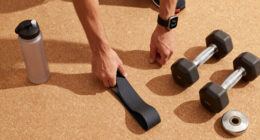
The circuit uses a mini loop band and a long resistance band. Its exercises are a chest-height woodchop, mini-band knee drive, lateral band walk, standing hip circle and low-to-high woodchop. Wilkinson’s prescribed volume is generally eight repetitions per side for the woodchops and hip circles, 10 knee drives per side and eight to 10 lateral steps in each direction.
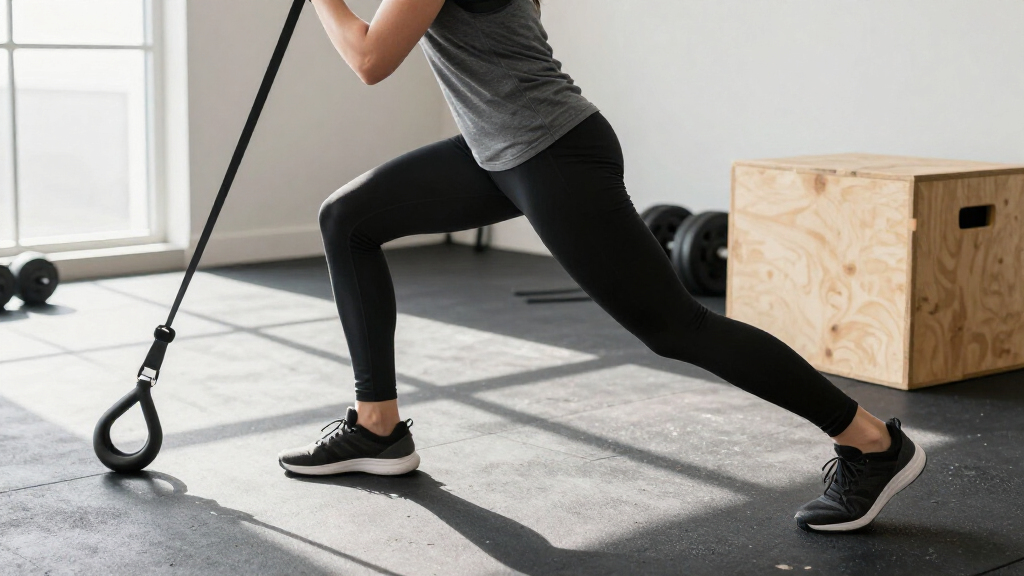
The sequence pairs controlled trunk rotation with movements that challenge the hips and balance. For example, the chest-height woodchop pulls a band horizontally across the body, while the low-to-high version moves from near the hip to above the opposite shoulder. The knee drive is performed one leg at a time against a mini band; the standing hip circle takes the working leg through a slow arc.
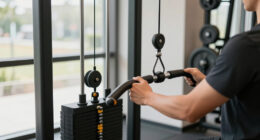
Fit&Well advises anchoring the long band to a fixed, load-bearing point and checking both the band and anchor before starting. It warns against using furniture that could slide or tip. Wilkinson also emphasizes controlled motion: allow the feet to pivot during rotational exercises, but avoid relying on momentum or twisting only through the arms.
Training Beyond Forward Motion
The workout offers readers a short, equipment-light way to add rotational and lateral patterns to a strength routine. Those directions are often absent from plans built mainly around straight-ahead movements, while ordinary tasks can involve turning, reaching, stepping sideways or balancing on one leg.
Wilkinson connects the exercises to activities such as climbing stairs, turning to pass an object and lifting something across the body. These are the trainer’s explanations of how the movements may relate to daily activity, not findings from a reported clinical trial. The article does not provide evidence that this particular circuit prevents injury or guarantees improvements in strength, balance or coordination.
The practical takeaway is the structure: a brief two-round circuit that can complement, rather than necessarily replace, other training. People can use the cues to focus on controlled movement and safe band setup, while adapting or stopping an exercise if it causes pain.
How the Five Moves Work
Wilkinson’s rationale is that bodies move in more than one direction, while many workouts emphasize forward-and-back patterns. “A lot of workouts will only move forward and backward, but life doesn’t happen in a straight line,” she says. She points to reaching sideways, turning to pick something up and steadying oneself after a stumble as examples of movement requiring control in different directions.
In her circuit, the lateral band walk adds side steps against resistance, with the band held at waist height. Wilkinson says this works the outer hip while holding the upper body steady. The standing hip circle similarly moves the leg through several directions rather than a single straight-line kickback. Her suggested schedule is two to three weekly sessions, with a two-minute rest after the first set before repeating the circuit.
The article is a workout recommendation, not a report of a new research study. It supplies exercise instructions and trainer commentary but no participant data, measured outcomes or comparison with other routines. Its suggested benefits should be read as the trainer’s rationale for the exercise selection.
“This trains rotational power through the torso at chest height.”
— Angela Wilkinson, on the chest-height woodchop
Evidence and Adaptations Remain Unspecified
The source does not state when the article was published, report a study testing the circuit or quantify its effects. It is therefore unclear how much the routine may improve strength, balance or coordination, or how its outcomes compare with other exercise programs.
Wilkinson’s suggested frequency and repetitions are general programming guidance in the article. It does not specify modifications for different fitness levels, mobility limitations or injuries, nor does it provide detailed advice on choosing band resistance. Readers should use a resistance they can control and seek professional guidance if they have a pre-existing condition or are unsure whether an exercise is appropriate.
Safe Setup Before Each Session
The source gives no announced follow-up study or next publication milestone. For anyone trying the routine, the immediate next steps are to check that the anchor is secure, inspect the bands and follow the controlled-motion cues. Perform the five exercises in sequence, rest for two minutes, then repeat for the second set; Wilkinson suggests doing the circuit two to three times weekly.
Readers should stop if a movement causes pain and adjust the exercise or seek qualified guidance as needed. Any claims about longer-term results would require outcome data that the source does not provide.
Key Questions
What exercises are in the workout?
The five moves are a chest-height woodchop, mini-band knee drive, lateral band walk, standing hip circle and low-to-high woodchop.
How often does the trainer recommend doing it?
Wilkinson suggests completing the circuit two to three times a week, with two sets of the exercises and a two-minute rest between sets.
What equipment is needed?
The routine calls for a mini loop band and a long resistance band. The long band must be attached to a fixed, load-bearing anchor that cannot slide or tip.
Does the source show that this workout prevents injuries?
No. Fit&Well presents Wilkinson’s exercise guidance and rationale but reports no study or measured evidence showing that the circuit prevents injuries or produces a specific improvement.
Source: rss