TL;DR

Get workout gear delivered free with Prime
- Fast, free delivery on millions of items
- Prime Video, Amazon Music and more included
- Member-only deals all year
A Fit&Well report recommends four exercises—sit-to-stand with knee lifts, a dumbbell hold with a leg raise, farmer carries and shoulder presses—to support strength and balance for everyday activities. The suggested routine uses two rounds, eight repetitions for most moves and 30-second carries; it is an instructor’s recommendation, not evidence that this exact program produces specific health outcomes.
Fit&Well has published a four-exercise routine recommended by a chair-workout instructor for building strength and balance in later life, with movements designed around tasks such as standing from a seat, carrying groceries and reaching overhead. The report suggests two rounds, using a sturdy chair and a pair of dumbbells, but it does not provide research showing that this specific routine produces particular outcomes.
The four moves are a seated knee lift followed by a sit-to-stand, a dumbbell hold paired with a side leg raise, a 30-second farmer carry and a shoulder press. The program calls for eight repetitions per side where relevant and two rounds overall. The farmer carry is performed for 30 seconds, followed by 30 seconds of rest.
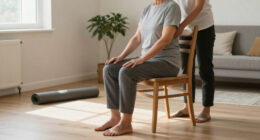
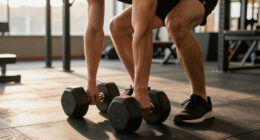
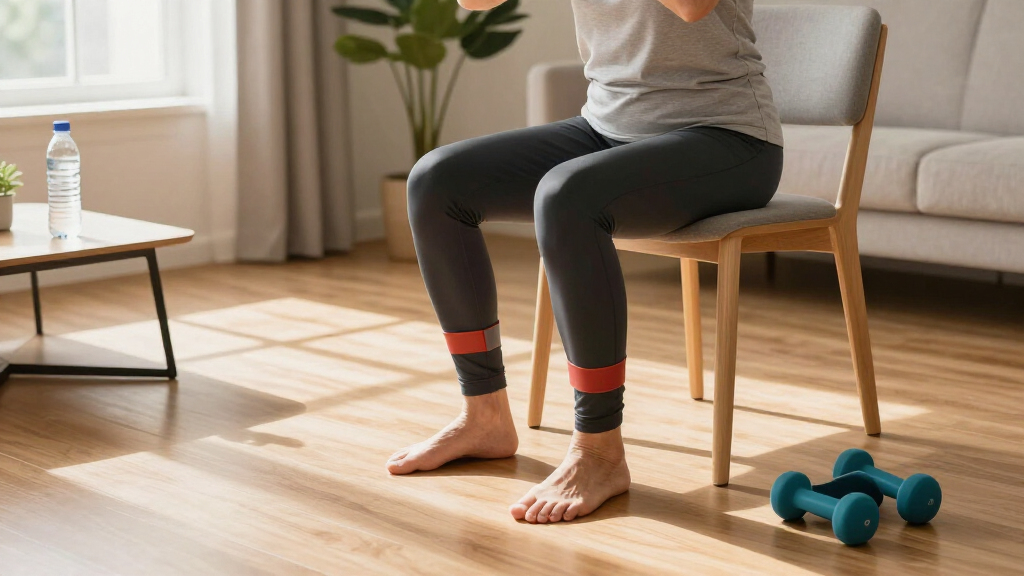
For the first move, the exerciser sits near the front of a sturdy chair, lifts each knee in turn, then stands and lowers back into the seat with control. The instructor links the knee lifts to moving the legs out of a car and the sit-to-stand to rising from a low seat. The side leg raise is performed while holding a dumbbell in the opposite hand; the report says the one-sided movement asks the hips and core to help keep the body steady.
For the carry, the exerciser walks around a room with a dumbbell in each hand, staying upright and avoiding a sideways lean. The shoulder press can be done seated or standing: weights start at shoulder height and are pressed overhead before being lowered slowly. The report advises choosing weights that can be controlled comfortably throughout each movement.
Strength for Everyday Independence
The routine is organized around practical movements rather than athletic performance: standing, walking while carrying weight and lifting overhead. That focus may help readers connect strength training with ordinary activities they want to maintain, rather than treating exercise only as a separate fitness goal.
The instructor says their older class members attend because they want to remain independent, citing examples including getting in and out of a car more easily and walking farther. Those examples are personal accounts from the instructor, not measured findings about the four-move plan. The report presents the exercises as a recommendation; it does not establish that they prevent falls, restore function after surgery or produce the same results for everyone.
The suggested use of a chair and manageable dumbbells also gives readers a defined starting format. Still, balance, strength and mobility vary, and people may need support or adaptations. The article’s practical value is its task-based approach, while the effect of this exact routine remains unquantified in the source.
Products Worth Considering

Bowflex SelectTech 840 Adjustable Kettlebell

Therabody Theragun Mini 3rd Generation Massage Gun, Black

Garmin Forerunner 165 GPS Running Smartwatch, 43 mm, Black
As an affiliate, we earn on qualifying purchases.
How the Four Moves Were Chosen
The report is based on the experience of an instructor who teaches chair-workout classes to people from their late 60s to early 90s. The instructor describes hearing from participants about daily activities that have become easier, including using a car and walking to a bus stop. One account concerns a client whose nurse commented on her upper-body strength after a hip replacement; the source does not give clinical details or independently verify the account.
The instructor also argues that preparing for later-life independence can begin earlier, recommending strength and balance practice in people’s 40s and 50s. The source does not set out a formal training plan for those age groups or compare the routine with other programs. Its four choices are explained through their connection to everyday actions: leg movement and rising, single-leg balance, carrying loads, and reaching overhead.
Evidence and Individual Suitability
The source does not identify a study testing this four-exercise routine, quantify changes in strength or balance, or report how long participants would need to follow it to notice a difference. Its examples are instructor-reported anecdotes, and the report does not establish that the routine prevents falls or improves outcomes after surgery.
It is also unclear whether the suggested repetitions and two rounds suit every reader. The report offers no detailed modifications for people with pain, restricted movement, medical conditions or difficulty standing safely. Anyone uncertain about exercise or using weights can seek guidance from a qualified health professional or exercise specialist; the source does not provide individual medical advice.
How Readers Can Start Safely
The report gives a basic structure rather than a progression schedule: two rounds, eight repetitions for each move or side, and two 30-second carries with 30 seconds of rest. It recommends a sturdy chair and dumbbells that remain controllable. It does not specify how often to repeat the session, when to increase weight or how to track progress.
Readers considering the routine can begin with a stable setup and movements they can perform with control, using the chair for support where needed. People with existing health conditions, recent surgery, pain or concerns about balance should ask a health professional about appropriate exercise and adaptations. No further study, expert review or update to the report is identified in the source material.
Key Questions
What are the four exercises?
The report recommends seated knee lifts with sit-to-stands, a dumbbell hold with a side leg raise, farmer carries and shoulder presses.
How many repetitions does the routine suggest?
It suggests two rounds and eight repetitions per side where relevant. Farmer carries are timed for 30 seconds, followed by 30 seconds of rest.
What equipment is needed?
The routine calls for a sturdy chair and a pair of dumbbells. The report advises using weights that can be controlled comfortably throughout each exercise.
Does the report prove these exercises prevent falls?
No. The source presents an instructor’s recommendations and participant anecdotes, but it does not cite research testing this routine or show that it prevents falls.
Should everyone use the same weights and movements?
The report does not provide individual adaptations. People with health conditions, recent surgery, pain or balance concerns can ask a qualified health professional or exercise specialist about suitable movements and support.
Source: rss