TL;DR

Get workout gear delivered free with Prime
- Fast, free delivery on millions of items
- Prime Video, Amazon Music and more included
- Member-only deals all year
Fit&Well reported that Pilates instructor Madison DiSalvo recommended four exercises that challenge the core to resist movement while the arms or legs move. The list includes dead bugs, bird dogs, bear planks and plank leg lifts, with suggested repetitions or hold times; the guidance is not presented as a clinical assessment or a guaranteed health outcome.
Fit&Well has published four exercises recommended by Pilates instructor Madison DiSalvo for challenging the deep core: dead bugs, bird dogs, bear planks and plank leg lifts. The routine focuses on keeping the torso and pelvis controlled while the limbs move, offering readers a practical set of exercises and suggested repetitions or hold times.
DiSalvo, identified by Fit&Well as an instructor at STRONG Pilates Commack, said Pilates builds stability through controlled movement coordinated with breathing. The report describes the target muscles as deep core muscles that help stabilize the torso, including the transverse abdominis, which it characterizes as a corset-like muscle below the ribs.
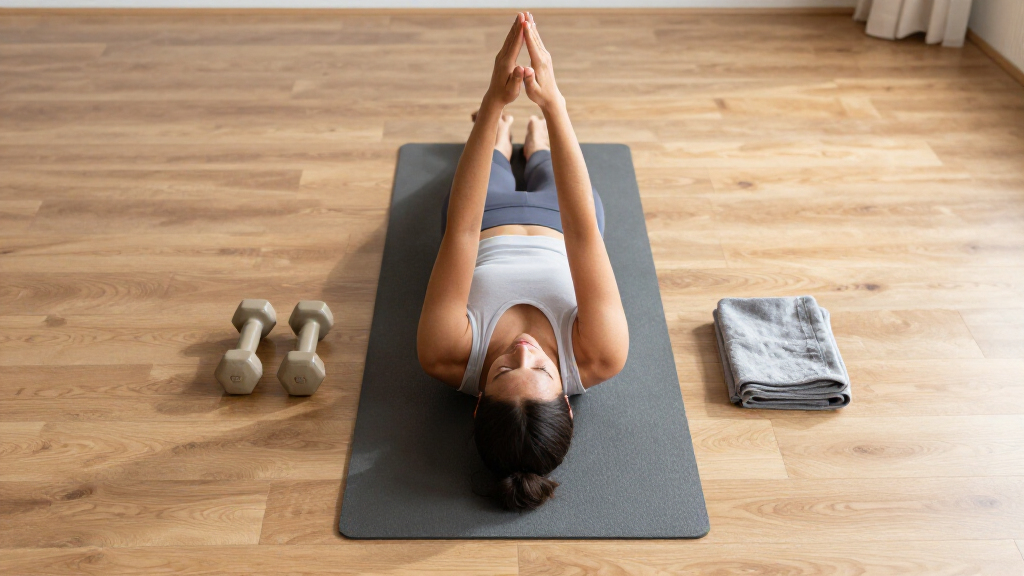
For the dead bug, the report recommends two to three sets of 10 to 15 repetitions per side. Lying on the back with knees bent and legs lifted, the exerciser lowers one arm and the opposite leg while trying to keep the spine, lower back and pelvis still. The movement should stop before the back arches, then the limbs return to the starting position before switching sides.
The other recommendations are bird dogs (two to three sets of 10 to 15 per side), a bear plank (three to five holds of 20 to 30 seconds) and a plank with alternating leg lifts (two to three sets of 10 to 12 per side). Across all four, the report emphasizes a neutral spine and controlled movement: avoid arching the lower back or allowing the pelvis to tilt or shift.
How The Routine Challenges Core Control
The common thread is not simply holding a plank or moving a limb; it is resisting unwanted movement through the trunk. DiSalvo’s selections pair arm or leg movement with cues to keep the pelvis and lower back steady. That makes the routine a concrete example of how a Pilates instructor might organize exercises around control, balance and coordination rather than speed or heavy resistance.
For readers, the report provides specific starting volumes and form cues, which can make the exercises easier to follow than a general instruction to “work the core.” It also distinguishes the drills by challenge: Fit&Well says the dead bug is more demanding for deep-core muscles, while the bird dog tests balance and coordination. These are the source’s descriptions, not a ranking established by comparative testing.
The health claims should be kept in proportion. The report says deep-core training can help with balance, posture and spinal health, but it does not provide study findings, clinical evidence for this particular four-move routine, or a promise that performing the exercises will prevent or treat a condition. The routine is best understood as exercise guidance from an instructor, not individualized medical or rehabilitation advice.
Four Moves And Their Form Cues
The sequence begins on the floor with the dead bug, where the back remains neutral as opposite limbs extend. In the bird dog, the exerciser moves from hands and knees, reaching one arm forward while lifting the opposite leg to about hip height. In both exercises, DiSalvo’s guidance centers on preventing the torso from rotating or the back from arching.
The bear plank raises the knees about one inch from the mat while the hands and toes remain grounded. The report advises keeping the back flat and the neck long, and suggests engaging the pelvic floor. The final move starts in a high plank, with alternating leg lifts; the pelvis should stay level and the body should not rock from side to side.
Breathing is part of the instruction: the report generally pairs preparation or lowering with an inhale and the more effortful movement with an exhale. It does not prescribe rest intervals, weekly frequency, progressions, or a specific order beyond presenting the four exercises. Readers should treat the listed sets and repetitions as the published suggestions, not as a program tailored to every fitness level.
“It builds foundational stability from the inside out.”
— Madison DiSalvo, Pilates instructor at STRONG Pilates Commack, as quoted by Fit&Well
What The Exercise Advice Does Not Establish
The source does not state when the report was published, identify research supporting the four-move selection, or explain how DiSalvo compared these exercises with other options. It also does not give information about participants, testing methods or measurable outcomes. The recommendation is attributed to one instructor, and the article material supplied here does not establish that the routine is the best choice for every person.
Details about suitability also remain limited. The report does not offer modifications for pain, injury, pregnancy, mobility limitations or different levels of strength, and it does not specify how to progress if the suggested repetitions or holds become easy. Anyone with a pre-existing condition, ongoing pain or concerns about exercise should seek guidance from a qualified health professional or instructor before attempting the movements. Stop if an exercise causes pain, and prioritize controlled form over completing the listed volume.
How Readers Can Apply The Guidance
Fit&Well’s report provides the exercise instructions and suggested volumes, but no follow-up study or additional update is included in the source material. Readers who choose to try the movements can begin with a range they can perform while maintaining the stated posture cues, rather than forcing a longer hold or more repetitions. The report’s central instruction is to keep the lower back and pelvis controlled as the limbs move.
For a personalized plan, a Pilates instructor or other qualified professional can assess technique and suggest adjustments. Any further evidence about the routine’s effects, recommended frequency or suitability for specific groups would require information beyond the report. Until then, the four exercises should be treated as general fitness suggestions, not a substitute for clinical advice.
Key Questions
Which four exercises did the instructor recommend?
Fit&Well reported that Madison DiSalvo recommended dead bugs, bird dogs, bear planks and plank leg lifts to challenge deep-core control.
How many dead bugs should I do?
The report suggests two to three sets of 10 to 15 repetitions per side. It advises extending opposite limbs while keeping the spine and pelvis steady, and stopping the leg movement before the back arches.
What is the main form cue across the four moves?
Keep the lower back and pelvis controlled. The report also advises maintaining a neutral spine and avoiding a tilted pelvis, an arched back or side-to-side shifting during the movements.
Are these exercises appropriate for everyone?
The report does not address every health condition or offer individualized modifications. People with pain, injuries or pre-existing conditions should consult a qualified health professional or instructor, and stop if a movement causes pain.
Source: rss
Fall Picks
fall essentials
As an affiliate, we earn on qualifying purchases.