
TL;DR

Get workout gear delivered free with Prime
- Fast, free delivery on millions of items
- Prime Video, Amazon Music and more included
- Member-only deals all year
Fit&Well published a five-minute evening Tai Chi routine recommended by teacher Brian Thompson, with seated breathing, gentle arm movements, weight shifts and self-massage. Thompson says it may help people unwind before bed, but the report does not provide research showing that the routine improves sleep.
Fit&Well has published a five-minute evening Tai Chi routine recommended by instructor Brian Thompson for people seeking a gentle way to unwind before bed. The sequence combines slow breathing, light movement and self-massage; Thompson says it may ease tension and help prepare the body for sleep, but the report does not establish that it treats insomnia or improves sleep outcomes.
The routine begins with one to two minutes of seated breathing. Practitioners sit upright on a sturdy chair with both feet flat on the floor and follow their natural breathing, while relaxing the stomach, shoulders and chest. The instruction is to let the breath rise and fall without forcing it.
Next comes a standing movement called “Lift Water,” repeated two or three times. With feet about shoulder-width apart, knees slightly bent and shoulders relaxed, the practitioner raises both arms to shoulder height while inhaling, then turns the palms forward and lowers the arms. The movements are meant to stay gentle and coordinated with the breath.
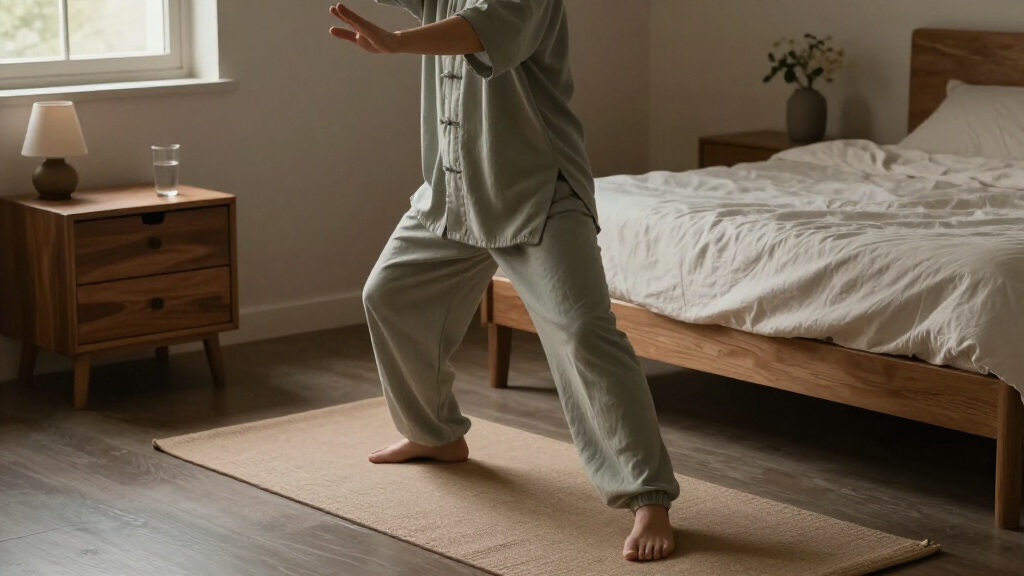
The longer movement section uses silk-reeling motions and slow weight shifts. The practitioner moves one hand across the body while turning the waist and shifting weight between bent legs, then switches sides and gradually uses both arms. The sequence ends beside the bed with gentle massage and cupped-hand pats on the neck, arms, torso and legs. The report presents these as steps in Thompson’s routine, not as a clinically tested treatment.
A Short Wind-Down Before Bed
The routine is brief and requires little equipment beyond a sturdy chair and space to stand. Its low-impact movements may appeal to people who want a quiet alternative to more vigorous late-night exercise, while the clear sequence gives readers a practical way to try gentle movement and breathing before bed.
That practical appeal should be kept separate from claims about sleep. Thompson, founder of BNEW4LIFE, says the routine can help release accumulated tension and quiet mental chatter. Those are his explanations for the practice; the Fit&Well material supplied here does not cite a trial, measured sleep outcomes or evidence that five minutes will help everyone fall asleep.
Readers experiencing persistent sleep problems should not treat the routine as a substitute for medical advice. A short relaxation practice may be one part of a bedtime routine, but the article does not show that it addresses the causes of ongoing insomnia.
How Thompson Describes the Practice
Tai Chi is described in the source report as an ancient Chinese practice using gentle, low-impact movement and breathing to build a mind-body connection. It can be practiced at different times of day; Thompson’s recommendation focuses specifically on an evening sequence for people who want to wind down.
Thompson says evening practice can address physical tension in the back, neck and shoulders that builds during the day. He also says coordinated movement and breathing may encourage a calmer state before bed. These are attributed descriptions of the intended effects, rather than conclusions supported by research findings included in the report.
“The benefit of an evening Tai Chi practice is that it helps to unwind accumulated physical tension in the back, neck and shoulders from the day.”
— Brian Thompson, Tai Chi teacher and founder of BNEW4LIFE, as quoted by Fit&Well
Sleep Benefits Remain Unverified
The material does not state whether the routine has been studied, how many people have tried it, or whether it changes the time needed to fall asleep or overall sleep quality. No measured outcome or comparison group is described, so the size and reliability of any sleep benefit cannot be assessed from this report.
It is also unclear whether the sequence is suitable for every reader. It includes standing, bending the knees and shifting weight, but the report does not set out adaptations for people with limited mobility or balance concerns. Anyone who feels unsteady or uncomfortable should stop and adapt the movements rather than push through them.
Readers Can Try the Sequence
The source report offers the routine as an optional five-minute evening practice; it gives no announced follow-up study, clinical assessment or further milestone. Readers who choose to try it can move slowly, keep the movements comfortable and use a stable chair for the seated opening. The report does not provide evidence that a particular duration or frequency produces a sleep benefit.
If sleep difficulties continue or affect daily life, readers can seek advice from a qualified health professional instead of relying on this routine alone. Whether the sequence helps an individual relax is something the supplied report does not quantify, and its sleep-related effects remain unconfirmed.
Key Questions
What does the five-minute Tai Chi routine include?
It includes seated breathing, gentle arm raises, slow silk-reeling movements with weight shifts, and a closing sequence of massage and cupped-hand pats.
Does the routine have proven benefits for insomnia?
The source report does not provide clinical research or measured sleep outcomes. Thompson describes potential relaxation and sleep benefits, but those claims are not established by evidence included in the report.
Can the movements be done in a small space?
The sequence uses a sturdy chair and standing movements, so it requires enough room to stand and shift weight safely. The report does not specify a minimum space or offer adaptations for people with mobility or balance limitations.
What should someone do if sleep problems persist?
The routine should not replace care for ongoing sleep difficulties. Consider speaking with a qualified health professional, particularly if poor sleep is persistent or affecting daily activities.
Source: rss
Fall Picks
fall essentials
As an affiliate, we earn on qualifying purchases.