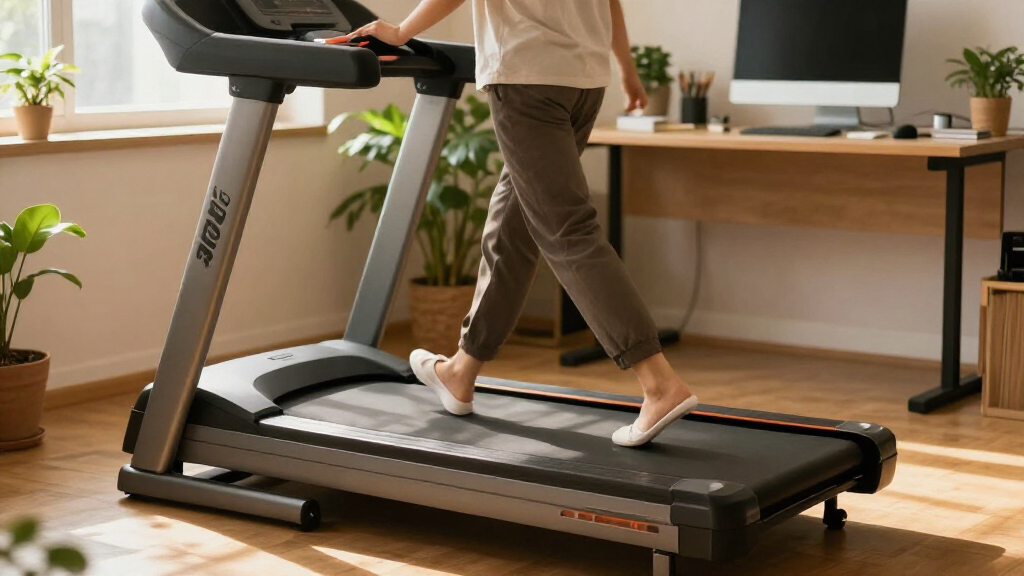
Among these under-desk treadmills, the MERACH UltraWalk W60 stands out as the best overall pick for buyers who want a substantial 12% automatic incline, while the THERUN’s 40-inch belt favors a longer walking surface and the Cybergoing T10 offers a fixed 7% incline with a Bosch motor. The lineup ranges from simple, remote-controlled pads to folding models with handrails, app features, or automatic incline. The main tradeoff is between a compact machine that fits easily under a desk and a more feature-rich model that can take up more room and call for more setup. Belt length, incline type, and whether you need handles can matter more to daily comfort than a long list of extras. Read on for the full comparison, buying guidance, and recommendations by user type.

Get workout gear delivered free with Prime
- Fast, free delivery on millions of items
- Prime Video, Amazon Music and more included
- Member-only deals all year
Complete the kit


Key Takeaways
- Automatic incline separates the feature-rich picks. The MERACH W60, TRAILVIBER, and WELLFIT list 12% auto incline; the Cybergoing T10 instead offers a fixed 7% incline, while several alternatives use manual adjustment.
- Belt length is a standout differentiator. The THERUN specifies a 40-inch belt, a useful point of comparison for buyers who want more walking room than a compact pad may provide.
- Handles change where and how a treadmill fits. The Viamotion, Yagud, and WELLFIT add folding handles or handrails, trading a simpler under-desk profile for extra support and a different storage footprint.
- Simple controls suit straightforward walking routines. TOUSAINS and the 5% manual-incline options from Walking Pad and Wilpkracy emphasize remote control and basic incline, unlike app-linked options such as UREVO and Chaoke.
- More features do not automatically mean a better desk fit. Models with handrails, speakers, apps, or incline hardware may suit varied workouts, while a portable, low-profile design may be the better match for limited workspace.
| Cybergoing T10 Walking Pad Treadmill with Bosch Motor and Fixed 7% Incline |  | Best for Incline Walking Under a Desk | Motor: Bosch motor | Speed range: 0.6–4 mph | Incline: Fixed 7% manual incline | VIEW LATEST PRICE | See Our Full Breakdown |
| Viamotion Folding Walking Pad Treadmill with Adjustable Incline and Handles |  | Best for Beginners Who Want Support Handles | Speed range: 0.6–3.8 mph | Maximum incline: 4 degrees, manual | Maximum horsepower: 2.5 hp | VIEW LATEST PRICE | See Our Full Breakdown |
| THERUN Under Desk Walking Pad Treadmill with 40-Inch Belt |  | Best for Moving Between Desk and Living Room | Speed range: 0.6–3.8 mph | Motor power: 2.5 HP | Maximum weight recommendation: 265 lb | VIEW LATEST PRICE | See Our Full Breakdown |
| TOUSAINS Walking Pad Treadmill with Remote |  | Best for a Longer Listed Belt | Motor power: 2.5 hp | Listed speed: 0.6 mph minimum; 0.64 mph maximum as described | Walking belt: 40 × 15 in | VIEW LATEST PRICE | See Our Full Breakdown |
| MERACH UltraWalk W60 Walking Pad Treadmill with 12% Auto Incline |  | Best Premium Pick for Adjustable Incline | Motor: 1.25 CHP / 3.5 HP peak brushless motor | Maximum speed: 4 mph | Incline: 12 levels, automatic; maximum 12% | VIEW LATEST PRICE | See Our Full Breakdown |
| Wilpkracy Walking Pad Treadmill with 5% Manual Incline and Remote Control |  | Best for Simple Incline Walking | Speed range: 0.6–4 mph | Incline: Manual, up to 5% | Walking area: 15 × 35.4 in | VIEW LATEST PRICE | See Our Full Breakdown |
| TRAILVIBER Walking Pad Treadmill with 12% Auto Incline |  | Best for High-Capacity Incline Walking | Speed range: 0.7–4 mph | Incline: Up to 12%, with 9 levels | Motor power: 2.5 HP | VIEW LATEST PRICE | See Our Full Breakdown |
| Yagud Walking Pad Treadmill with Foldable Handles |  | Best for Light, Space-Conscious Walking | Speed range: 0.6–3.8 mph | Maximum incline: 4% | Maximum horsepower: 2.5 hp | VIEW LATEST PRICE | See Our Full Breakdown |
| Vhorilix Portable Under-Desk Walking Pad Treadmill |  | Best Value for Basic Daily Walking | Speed range: 0.6–4 mph | Motor: 2.5 HP, 480 W | Maximum user weight: 264 lb | VIEW LATEST PRICE | See Our Full Breakdown |
| Chaoke 4-in-1 Walking Pad Treadmill with 10% Incline, App, Built-In Speaker, and Remote |  | Best for Faster, Varied Home Workouts | Speed range: 0.6–6.2 mph | Incline: 10% | Motor: 2.75 HP brushless | VIEW LATEST PRICE | See Our Full Breakdown |
| WELLFIT Foldable Walking Pad Treadmill with 12% Auto Incline and Handrails |  | Best for Supported Incline Training | Motor: 3.5 HP brushless | Speed range: 0.6–7.6 MPH | Maximum incline: 12% automatic | VIEW LATEST PRICE | See Our Full Breakdown |
| Vyrqenoxi Foldable Walking Pad Treadmill with Manual Incline |  | Best for Compact Storage and Preset Workouts | Running area: 35 × 14.4 inches | Folded dimensions: 40.5 × 18 × 4.7 inches | Speed range: 0.6–6.2 mph | VIEW LATEST PRICE | See Our Full Breakdown |
| UREVO Smart Incline Treadmill Walking Pad with AI App |  | Best for App-Connected Walking and Running | Speed range: 0.6–6.2 mph maximum | Walking mode: 0.6–4 mph | Maximum incline: 11% | VIEW LATEST PRICE | See Our Full Breakdown |
| Superun 6% Incline Under-Desk Walking Treadmill |  | Best for Steady Desk Walking | Speed range: 0.6–3.8 mph | Motor power: 2.5 HP | Maximum incline: 6% manual | VIEW LATEST PRICE | See Our Full Breakdown |
| Wilpkracy Walking Pad Treadmill with 5% Manual Incline and Remote Control |  | Best for Simple, No-Assembly Walking | Speed range: 0.6–4 mph | Maximum incline: 5% manual | Maximum horsepower: 2 hp | VIEW LATEST PRICE | See Our Full Breakdown |
| under desk treadmill | Speed range | Dimensions | Weight |
|---|---|---|---|
| Cybergoing T10 Walking Pad Tre | 0.6–4 mph | 5.7 × 19.3 × 42.3 in (D × W × H) | 36.4 lb |
| Viamotion Folding Walking Pad | 0.6–3.8 mph | 45.53 × 21.17 × 37.4 in | 18 kg |
| THERUN Under Desk Walking Pad | 0.6–3.8 mph | 41.9 × 19.6 × 4.17 in | 34.4 lb |
| TOUSAINS Walking Pad Treadmill | — | — | 46.3 lb |
| MERACH UltraWalk W60 Walking P | — | — | 67.7 lb |
| Wilpkracy Walking Pad Treadmil | 0.6–4 mph | 43.7 × 22 × 4.7 in | 35.8 lb |
| TRAILVIBER Walking Pad Treadmi | 0.7–4 mph | 48 × 21 × 6 in | — |
| Yagud Walking Pad Treadmill wi | 0.6–3.8 mph | 45.1 × 19.6 × 4.4 in | 36.5 lb |
| Vhorilix Portable Under-Desk W | 0.6–4 mph | Listed as 109 × 50 × 11 cm and 40 × 19 × 4 in | Listed as approximately 16–17 kg |
| Chaoke 4-in-1 Walking Pad Trea | 0.6–6.2 mph | 116 × 48.5 × 11.5 cm | — |
| WELLFIT Foldable Walking Pad T | 0.6–7.6 MPH | — | — |
| Vyrqenoxi Foldable Walking Pad | 0.6–6.2 mph | — | — |
| UREVO Smart Incline Treadmill | 0.6–6.2 mph maximum | — | — |
| Superun 6% Incline Under-Desk | 0.6–3.8 mph | 42.5 × 24.5 × 41.28 inches | 41.3 lbs |
| Wilpkracy Walking Pad Treadmil | 0.6–4 mph | — | — |
More Details on Our Top Picks
Cybergoing T10 Walking Pad Treadmill with Bosch Motor and Fixed 7% Incline
The Cybergoing T10 suits desk walkers who want a more demanding walk without adding a bulky handrail frame. Its fixed 7% incline provides a steady uphill challenge, while app and remote controls let you adjust speed from 0.6 to 4 mph. Compared with the MERACH UltraWalk W60, the T10 is much lighter and easier to shift around, but its incline cannot be varied during a workout and its 15-inch belt is narrower. The 300 lb capacity is a useful allowance for a compact pad, though the short, narrow deck may feel restrictive for longer strides. I’d pick it for steady uphill walking rather than flexible training: the incline is always part of the setup, and the 4 mph ceiling rules out running.
Pros:- Fixed 7% incline adds a walking challenge without a large treadmill frame.
- At 36.4 lb, it is lighter than the MERACH UltraWalk W60 and easier to reposition.
- App and remote controls offer two ways to adjust speed.
- 300 lb maximum capacity is generous for a compact walking pad.
Cons:- The incline is fixed and must be set before walking.
- The 15-inch belt may feel narrow, especially for users with a wider stride.
- Maximum speed of 4 mph limits it to walking and brisk walking.
Best for: Desk workers who want a compact pad for steady uphill walking and value a 300 lb capacity.
Not ideal for: Users who want to change incline during a workout, need a wider walking surface, or plan to run.
- Motor:Bosch motor
- Speed range:0.6–4 mph
- Incline:Fixed 7% manual incline
- Maximum weight capacity:300 lb
- Belt dimensions:15 × 36 in
- Dimensions:5.7 × 19.3 × 42.3 in (D × W × H)
- Weight:36.4 lb
- Controls:App and remote
- Warranty:12 months
Our verdict“Choose the Cybergoing T10 if you want a light under-desk pad with a constant uphill challenge, not adjustable incline or running speed.”
Viamotion Folding Walking Pad Treadmill with Adjustable Incline and Handles
The Viamotion Folding Walking Pad is a good fit for new desk-treadmill users who prefer handles for balance when stepping on, starting, or walking away from a desk. Its handles fold for storage, and the manual 4-degree incline adds some variety without requiring a powered incline system. The 0.6–3.8 mph range keeps this firmly in walking territory. Compared with the handle-free Cybergoing T10, Viamotion offers more physical support and a folding design, but it has a lower 265 lb weight recommendation and a plastic frame. The stated 45 dB noise level and brushless motor are aimed at quieter indoor use, though the product data does not specify an under-desk height or belt dimensions. I’d favor it for cautious beginners over users seeking a sturdier-feeling, wide-deck walking surface.
Pros:- Foldable handles offer balance support and can be folded for storage.
- Manual incline and adjustable speed provide more workout options than a flat-only pad.
- LED display tracks time, distance, speed, and calories.
- Listed 45 dB noise level and brushless motor are suited to quieter indoor walking.
Cons:- Plastic frame may be less appealing to buyers seeking a metal construction.
- 265 lb maximum weight recommendation is lower than the Cybergoing T10 and MERACH W60.
- Maximum speed of 3.8 mph is for walking, not running.
Best for: First-time walking-pad buyers who want foldable balance handles and a compact unit for light home or desk walking.
Not ideal for: Heavier users above the 265 lb recommendation, or buyers who prioritize a metal frame and a clearly specified wide belt.
- Speed range:0.6–3.8 mph
- Maximum incline:4 degrees, manual
- Maximum horsepower:2.5 hp
- Maximum weight recommendation:265 lb
- Dimensions:45.53 × 21.17 × 37.4 in
- Folded size:45.53 × 21.17 × 40.47 in
- Weight:18 kg
- Noise level:45 dB
- Warranty:One-year motor warranty
Our verdict“Pick Viamotion if foldable support handles matter more than a higher capacity or a metal frame.”
THERUN Under Desk Walking Pad Treadmill with 40-Inch Belt
The THERUN Under Desk Walking Pad is the most versatile choice here for buyers who want one machine for workday walking and light standalone jogging. Its speed range reaches 3.8 mph, and transport wheels make it easier to move out of the way when desk time is over. The five-layer anti-slip belt and silicone shock absorption are intended to soften the feel of each step. Compared with the Viamotion Folding Walking Pad, THERUN uses an alloy-steel frame and does not rely on foldable handles, but its listed belt length is only 35.5 inches—not the 40 inches suggested by its title. Capacity is also listed at 265 lb, despite conflicting product highlights. Those discrepancies make the fit less certain, so I’d choose it for portability and simple dual-use flexibility, not for buyers who need a verified long deck or higher weight limit.
Pros:- Transport wheels and a 34.4 lb weight make it easier to reposition than the MERACH W60.
- Speed range supports desk walking and light standalone jogging.
- Five-layer anti-slip belt and silicone shock absorption are designed for a more cushioned step.
- Alloy-steel frame and no-assembly setup suit buyers wanting a straightforward portable unit.
Cons:- Listed belt length is 35.5 inches, despite the 40-inch claim in the title.
- Maximum weight recommendation is 265 lb, conflicting with some product highlights that claim 300 lb.
- At 15 inches wide, the belt offers limited room for wider strides.
Best for: People who want a no-assembly walking pad that can move between an under-desk setup and casual light jogging.
Not ideal for: Buyers who need a confirmed 40-inch belt, a capacity above 265 lb, or a wider deck for a long stride.
- Speed range:0.6–3.8 mph
- Motor power:2.5 HP
- Maximum weight recommendation:265 lb
- Running belt:35.5 × 15 in
- Dimensions:41.9 × 19.6 × 4.17 in
- Weight:34.4 lb
- Frame material:Alloy steel
- Controls and display:Remote control and smart LED display
- Warranty:1 year
Our verdict“Choose THERUN for a portable desk-to-room walking pad, but skip it if the conflicting belt-length and capacity claims affect your fit.”
TOUSAINS Walking Pad Treadmill with Remote
The TOUSAINS Walking Pad stands out on paper for its 40 × 15-inch belt, which is longer than the listed deck on the THERUN and may give desk walkers more room front to back. Its remote, LED readout, and transport wheels keep the setup simple for everyday walking in a home office. The metal construction and 300 lb capacity also compare favorably with the Viamotion, which has a plastic frame and a lower weight recommendation. The major caveat is unusually important: the maximum speed is listed as 0.64 mph, an apparent conflict with the stated 0.6 mph minimum and the general walking-pad description. I would not assume it can reach a useful brisk-walking pace without confirming the speed range with the seller. This is a basic walking option, but its unclear speed specification keeps it behind more clearly documented picks.
Pros:- Listed 40-inch belt is longer than the THERUN’s specified 35.5-inch belt.
- Metal construction and 300 lb capacity compare well with lighter-duty options such as Viamotion.
- Remote and LED display keep speed adjustments and basic workout information accessible.
- Transport wheels help with repositioning in a home office.
Cons:- Maximum speed is listed as 0.64 mph, creating uncertainty about its usable speed range.
- At 46.3 lb, it is heavier than the Cybergoing T10 and THERUN for moving between rooms.
- The specifications do not establish a faster pace for brisk walking.
Best for: Home-office users who want a simple remote-controlled pad and value a longer listed belt and 300 lb capacity.
Not ideal for: Buyers who need a dependable brisk-walking pace or want clear, consistent speed specifications before choosing.
- Motor power:2.5 hp
- Listed speed:0.6 mph minimum; 0.64 mph maximum as described
- Walking belt:40 × 15 in
- Overall dimensions:47 × 19.5 × 5 in
- Weight:46.3 lb
- Maximum weight capacity:300 lb
- Material:Metal
- Controls and display:Remote control and LED display
- Warranty:1 year
Our verdict“Consider TOUSAINS for a longer listed belt and simple desk walking only if you can confirm its actual speed range first.”
MERACH UltraWalk W60 Walking Pad Treadmill with 12% Auto Incline
The MERACH UltraWalk W60 is the strongest fit for buyers who want more than a flat under-desk stroll: its 12-level automatic incline changes the walking effort without requiring a manual reset. The 16.5 × 41.3-inch deck is also wider and longer than the Cybergoing T10’s 15 × 36-inch belt, giving users more stride room. A 400 lb maximum capacity is paired with a lower recommended sustained limit of 330 lb, so I’d use the latter as the practical guide. Safety key and child lock add useful safeguards in shared homes. The tradeoff is bulk: at 67.7 lb and 51.4 inches long, it is much less convenient to shift than the THERUN. It also tops out at 4 mph, so the added incline creates workout variety, not running capability.
Pros:- Twelve automatic incline levels allow effort changes without stopping to reset the deck.
- 16.5 × 41.3-inch walking deck is roomier than the Cybergoing T10’s belt.
- 330 lb recommended sustained capacity and 400 lb maximum capacity support a broader range of users.
- Safety key, child lock, and transport wheels add practical features for shared home use.
Cons:- At 67.7 lb, it is substantially heavier than the THERUN and harder to move often.
- The 4 mph maximum speed is for walking and brisk walking, not running.
- Requires corded electric power and has a larger footprint than compact walking pads.
Best for: Desk workers seeking a wider deck, automatic incline variety, and a higher sustained weight recommendation for walking workouts.
Not ideal for: People with very limited storage or anyone who needs a lightweight pad, faster running speeds, or a non-corded treadmill.
- Motor:1.25 CHP / 3.5 HP peak brushless motor
- Maximum speed:4 mph
- Incline:12 levels, automatic; maximum 12%
- Maximum weight capacity:400 lb
- Recommended sustained capacity:330 lb
- Walking deck:16.5 × 41.3 in
- Overall dimensions:51.4 × 22 × 6.5 in
- Weight:67.7 lb
- Warranty:3 years
Our verdict“Choose the MERACH W60 if adjustable incline and a roomier deck outweigh the need for a lightweight, easy-to-store pad.”
Wilpkracy Walking Pad Treadmill with 5% Manual Incline and Remote Control
For a straightforward under-desk routine with some added resistance, this Wilpkracy walking pad pairs a manual incline of up to 5% with a walking-focused speed range. The incline can make a steady walk more demanding without the automatic adjustment system found on the TRAILVIBER, which reaches 12% and has nine incline levels. In exchange, this model is simpler: it arrives assembled, and its remote handles speed, pause, and stop. The 15 × 35.4-inch belt is relatively compact, though, so longer-striding users may prefer a roomier option such as the Vhorilix, whose listed walking area is longer. Its 4 mph ceiling suits walking rather than running. I’d choose it for uncomplicated use, but skip it if a spacious deck or push-button incline changes matter more.
Pros:- Manual incline up to 5% adds resistance without relying on automatic adjustment.
- Remote controls speed, pause, and stop, which is convenient during desk use.
- Arrives without assembly and has a compact profile for storage under suitable furniture.
- Textured, cushioned belt is designed to support traction and comfort.
Cons:- The 15 × 35.4-inch walking area may feel short or narrow for some users.
- The 4 mph maximum is intended for walking, not running.
- Manual incline adjustment is less convenient than the TRAILVIBER’s automatic incline controls.
Best for: Desk workers who want a no-assembly walking pad with a manual incline for occasional, more effortful walks.
Not ideal for: Taller users with a long stride or anyone who wants to run, since the belt is compact and speed tops out at 4 mph.
- Speed range:0.6–4 mph
- Incline:Manual, up to 5%
- Walking area:15 × 35.4 in
- Dimensions:43.7 × 22 × 4.7 in
- Weight:35.8 lb
- Display:Time, distance, calories, and speed
- Belt:Five-layer, diamond-pattern textured belt
- Assembly:No assembly required
Our verdict“Choose this Wilpkracy if you want simple, assembled walking with a modest manual incline and do not need a long belt or running speed.”
TRAILVIBER Walking Pad Treadmill with 12% Auto Incline
The TRAILVIBER is the strongest fit here for users who want substantial incline walking without stepping up to a handrail-style treadmill. Its nine automatic incline levels reach 12%, well beyond the manual 5% setting on the Wilpkracy, and the listed 450 lb capacity is the highest among these five options. That combination makes it a more versatile choice for varied walking sessions and a wider range of users. The 4 mph maximum still keeps it in walking territory, while the 41 × 16.5-inch deck offers more length than the Wilpkracy’s listed walking area. Bluetooth audio, FitYo tracking, and an RGB display add connected features, but they may be unnecessary for someone who just wants a basic desk treadmill. It also needs a corded outlet and weighs 44 lb.
Pros:- Nine automatic levels provide incline adjustment up to 12%.
- Listed 450 lb weight capacity exceeds the other models in this batch.
- 41 × 16.5-inch deck provides more walking length than the Wilpkracy’s 15 × 35.4-inch area.
- Bluetooth, FitYo app tracking, and a three-year warranty are included.
Cons:- The 4 mph speed ceiling limits it to walking rather than running.
- At 44 lb, it is heavier than the Wilpkracy and Vhorilix models.
- Corded electric operation requires access to an outlet.
Best for: Users seeking a higher-capacity under-desk treadmill with automatic incline changes and app-linked workout tracking.
Not ideal for: Runners or buyers who want a lightweight, cordless-to-use setup; its speed is capped at 4 mph, and it requires a power cord.
- Speed range:0.7–4 mph
- Incline:Up to 12%, with 9 levels
- Motor power:2.5 HP
- Maximum weight capacity:450 lb
- Deck dimensions:41 × 16.5 in
- Dimensions:48 × 21 × 6 in
- Item weight:44 lb
- Connectivity:Bluetooth and FitYo app
- Warranty:3 years
Our verdict“Pick the TRAILVIBER for automatic, steep incline walking and a high stated capacity, but not for running or a particularly light machine.”
Yagud Walking Pad Treadmill with Foldable Handles
For a compact desk setup where easy repositioning matters more than incline or speed, the Yagud keeps the feature set practical: transport wheels, a remote, and an LED display for basic workout metrics. Its 3.8 mph limit is slightly lower than the 4 mph offered by the Wilpkracy and Vhorilix, so it is best treated as a walking pad rather than a machine for running. Silicone shock absorbers and a five-layer non-slip belt are intended to soften each step, while its 45.1-inch length gives it a longer overall footprint than the Wilpkracy. One caution is the conflicting capacity information: the description says 220 lb, while the specifications list 265 lb. I would not choose it based on the higher figure without confirming the limit with the seller.
Pros:- Built-in wheels make it easier to reposition and store.
- Remote adjusts speed and starts or stops the treadmill.
- LED display tracks speed, distance, time, and calories.
- Five-layer non-slip belt and silicone shock absorbers are designed for cushioned walking.
Cons:- Maximum speed of 3.8 mph is lower than the 4 mph limits on the Wilpkracy and Vhorilix.
- Weight capacity is inconsistent across the product information: 220 lb in the description and 265 lb in the specifications.
- A stated 4% maximum incline is modest compared with the TRAILVIBER’s 12% incline.
Best for: Apartment dwellers and desk workers who prioritize moving a walking pad between rooms and mostly walk at a measured pace.
Not ideal for: Buyers who need a confirmed higher weight limit, faster speeds, or a clear advantage in incline; the capacity figures conflict and speed tops out at 3.8 mph.
- Speed range:0.6–3.8 mph
- Maximum incline:4%
- Maximum horsepower:2.5 hp
- Weight recommendation:Conflicting listings: 220 lb in description and 265 lb in specifications
- Dimensions:45.1 × 19.6 × 4.4 in
- Weight:36.5 lb
- Display metrics:Distance, speed, time, and calories
- Belt and cushioning:Five-layer non-slip belt with silicone shock absorbers
Our verdict“Choose the Yagud for easy room-to-room movement and light walking, but verify its capacity before buying if that limit matters.”
Vhorilix Portable Under-Desk Walking Pad Treadmill
The Vhorilix focuses on the essentials for everyday desk walking: speeds from 0.6 to 4 mph, a remote, an LED readout, and built-in wheels. Its listed 38.5 × 94 cm belt is longer than the Wilpkracy’s 15 × 35.4-inch walking area, making it the more appealing of the two for buyers who want a little more room without moving to the wider-featured TRAILVIBER. A diamond-textured, five-layer belt and shock absorbers are intended to cushion steps, and the low-profile frame is designed to fit under furniture. There are no app or audio features like the TRAILVIBER’s, and the product information gives differing weights and dimensions. I’d treat this as a practical basic option, but confirm the measurements and weight if storage clearance or moving it often will be tight.
Pros:- 38.5 × 94 cm walking area is longer than the Wilpkracy’s listed walking area.
- Built-in wheels and a low-profile design support moving and under-furniture storage.
- Remote control and LED display cover common speed and workout-tracking tasks.
- Five-layer anti-slip belt and shock absorbers are designed to reduce walking impact.
Cons:- Maximum speed of 4 mph limits it to walking rather than running.
- Product information lists different dimensions and weights, so storage planning may require confirmation.
- It lacks the automatic incline and app features offered by the TRAILVIBER.
Best for: Desk workers who want a simple 4 mph walking pad with wheels, a remote, and a relatively long listed belt.
Not ideal for: Buyers who want incline adjustment, app features, or fully consistent measurements before planning a tight furniture fit.
- Speed range:0.6–4 mph
- Motor:2.5 HP, 480 W
- Maximum user weight:264 lb
- Walking area:38.5 × 94 cm
- Dimensions:Listed as 109 × 50 × 11 cm and 40 × 19 × 4 in
- Weight:Listed as approximately 16–17 kg
- Display metrics:Speed, distance, workout time, and calories
- Belt:Five-layer anti-slip belt with diamond-textured surface
- Assembly:No assembly required
Our verdict“The Vhorilix suits buyers who want straightforward daily walking and wheels, provided they verify its listed dimensions and weight first.”
Chaoke 4-in-1 Walking Pad Treadmill with 10% Incline, App, Built-In Speaker, and Remote
The Chaoke is the most workout-oriented choice in this batch: its speed reaches 6.2 mph, and its 10% incline, 12 HIIT programs, and app connectivity extend it beyond the walking-only pace of the Wilpkracy and Vhorilix. That extra range makes it a better fit for users who want to alternate desk walking with faster sessions when the desk is out of the way. A brushless 2.75 HP motor, built-in speaker, remote, and cushioned five-layer belt round out the setup; the listing also gives a 330 lb capacity. The tradeoff is that its compact dimensions still do not offer the running space of a full-size treadmill, and 6.2 mph may be too slow for faster runners. It is also more feature-heavy than a buyer seeking only a quiet, simple walking pad needs.
Pros:- 6.2 mph maximum speed supports faster sessions than the 4 mph Wilpkracy and Vhorilix.
- 10% incline and 12 HIIT programs offer more workout variety than the walking-focused models.
- App connectivity, built-in speaker, and remote add multiple ways to control or follow workouts.
- Pre-assembled construction and two wheels make setup and movement simpler.
Cons:- The compact dimensions provide less running space than a full-size treadmill.
- A 6.2 mph ceiling may not suit users who run at higher speeds.
- Its app, programs, and speaker may be unnecessary for someone seeking a basic under-desk walking pad.
Best for: Home workers who want one compact treadmill for desk walking and occasional faster intervals or programmed workouts.
Not ideal for: Runners who need a full-size deck or speeds above 6.2 mph, and buyers who want only a basic walking pad without connected features.
- Speed range:0.6–6.2 mph
- Incline:10%
- Motor:2.75 HP brushless
- Weight capacity:330 lb
- Programs:12 HIIT programs
- Connectivity:App connectivity
- Shock absorption:Eight silicone shock absorbers and two cushioning pads
- Dimensions:116 × 48.5 × 11.5 cm
- Assembly:Pre-assembled
Our verdict“Choose the Chaoke if you want a compact machine that can move beyond desk walking, but skip it if you need a full-size running deck or only want basic walking controls.”
WELLFIT Foldable Walking Pad Treadmill with 12% Auto Incline and Handrails
The WELLFIT is the most workout-oriented choice here for someone who wants incline variation and more support than a basic under-desk pad provides. Its 0–12% automatic incline adjusts without stopping to reposition the machine, while extended dual handrails offer added stability for brisk walking or light jogging. Compared with the Superun 6% Incline, WELLFIT gives you a steeper, motorized incline and a faster top speed; it is also heavier-duty on paper, with a 375-pound capacity. The tradeoff is a relatively short 40 × 16-inch belt, which may constrain longer strides, and its handrails and 41.7-inch height make it less like a flat pad that disappears under a desk. It folds to 5.5 inches and has transport wheels, but needs a power outlet.
Pros:- Automatic incline adjusts from 0% to 12% without manual repositioning.
- Extended dual handrails add support for faster walking and light jogging.
- Shock absorbers and a seven-layer belt are designed to cushion steps.
- Folds to 5.5 inches and includes transport wheels for storage.
Cons:- The 40 × 16-inch belt may feel short or narrow for users with longer strides.
- Handrails and overall height make it less suited to use directly beneath many desks.
- Corded electric power limits placement to areas near an outlet.
Best for: Home-office users who want powered incline changes, handrail support, and the option to walk or jog.
Not ideal for: Buyers seeking a low-profile treadmill to use beneath a desk while seated or to store in a very tight space; its raised handrails and 41.7-inch overall height need room.
- Motor:3.5 HP brushless
- Speed range:0.6–7.6 MPH
- Maximum incline:12% automatic
- Weight capacity:375 lbs
- Running belt:40 × 16 inches; seven-layer anti-slip belt
- Noise level:Under 40 dB
- Folded height:5.5 inches
- Controls and connectivity:Console buttons, remote, voice commands, Wellfit App, Bluetooth
Our verdict“Choose WELLFIT if you want powered incline and handrail support more than a flat, desk-first profile.”
Vyrqenoxi Foldable Walking Pad Treadmill with Manual Incline
Vyrqenoxi makes the most sense for buyers who value a compact folded footprint and guided workout variety over a powered incline or a high user-weight limit. Its 12 preset programs and time, distance, and calorie countdowns give a small walking pad more structure than the simpler Wilpkracy, which relies on manual speed changes and a remote. Folded dimensions of 40.5 × 18 × 4.7 inches make it easier to slide beneath a bed or sofa, and transport wheels help with repositioning. The compromises are clear: the 35 × 14.4-inch deck is notably compact, the incline must be adjusted manually, and the recommended capacity is 220 pounds. Its 6.2 mph maximum supports a wider pace range than the Superun, but the short deck is not a strong match for sustained running.
Pros:- Folds to 4.7 inches high for storage beneath many beds or sofas.
- Twelve preset programs and three countdown modes add workout structure.
- Transport wheels and safety handrails support repositioning and stability.
- Speed reaches 6.2 mph, giving it more pace range than walking-only models such as Superun.
Cons:- Manual incline requires stopping to adjust rather than changing it during a workout.
- The 35 × 14.4-inch running area may restrict stride length and running comfort.
- The 220-pound recommended capacity is lower than WELLFIT’s 375-pound capacity.
Best for: Apartment dwellers under the 220-pound limit who want a compact pad with preset routines and countdown targets.
Not ideal for: Taller users with long strides, buyers who need powered incline adjustment, or anyone above the stated 220-pound weight recommendation.
- Running area:35 × 14.4 inches
- Folded dimensions:40.5 × 18 × 4.7 inches
- Speed range:0.6–6.2 mph
- Motor power:480 W
- Maximum recommended weight:220 lbs (100 kg)
- Workout programs:12 preset programs
- Incline:Manual
- Belt:Five-layer, non-slip
Our verdict“Pick Vyrqenoxi for compact storage and guided walking sessions if its small deck and 220-pound limit fit your needs.”
UREVO Smart Incline Treadmill Walking Pad with AI App
UREVO is the app-focused pick for buyers who want a compact pad that can move beyond gentle desk walking. Its walking and running modes separate the speed ranges, and Bluetooth links the machine to the UREVO Fitness app for workout tracking and virtual routes. That makes it a more connected option than the Vyrqenoxi, which offers preset programs but no listed app connection. The 11% incline adds a meaningful workout variable, though it falls just short of WELLFIT’s 12% maximum and does not come with WELLFIT’s extended handrails. At 43 pounds with a four-inch folded profile, it is easier to move and tuck away than a larger rail-equipped treadmill. Its 36-inch deck is the key compromise: useful for compact walking, but limiting for runners who need more room.
Pros:- UREVO Fitness app connects over Bluetooth for tracking and virtual routes.
- Separate walking and running modes offer different speed ranges.
- An 11% maximum incline adds more challenge than the Superun’s 6% incline.
- Four-inch folded profile and 43-pound weight support easier storage and relocation.
Cons:- The 36-inch deck may feel restrictive for running or longer strides.
- Maximum speed is 6.2 mph, below WELLFIT’s 7.6 mph top speed.
- Its stated 265-pound weight recommendation is lower than WELLFIT’s 375-pound capacity.
Best for: Tech-oriented home walkers who want app tracking, virtual routes, incline, and occasional short-stride running.
Not ideal for: Runners who need a long deck or buyers who want extended handrails and a higher top speed than 6.2 mph.
- Speed range:0.6–6.2 mph maximum
- Walking mode:0.6–4 mph
- Maximum incline:11%
- Maximum horsepower:2.25 hp
- Maximum weight recommendation:265 lbs
- Deck dimensions:36 × 15 inches
- Folded dimensions:45 × 22 × 4 inches
- Connectivity:Bluetooth; UREVO Fitness App
Our verdict“Choose UREVO if app-connected workouts and a compact incline pad matter more than a long running deck.”
Superun 6% Incline Under-Desk Walking Treadmill
Superun is the most desk-focused choice in this group for buyers who want a simple walking pace and do not need running speeds. Its 0.6–3.8 mph range keeps the emphasis on walking, while side support rails, an LED display, remote control, and PitPat app connectivity cover the basics. Compared with the Wilpkracy, Superun adds side rails and a higher 300-pound user limit; compared with WELLFIT, it is less capable for steep or fast workouts but better aligned with a steady walking routine. The 6% incline is manual, so it cannot change on the fly, and the 35.4 × 14.96-inch deck remains compact. At 41.3 pounds, it is movable with its wheels but not especially light. No assembly is required, which lowers setup effort.
Pros:- Walking-focused speed range suits steady use during work.
- Side support rails provide more stability than the rail-free Wilpkracy.
- Six percent manual incline adds uphill-style walking variety.
- No assembly is required, and wheels help with storage and repositioning.
Cons:- The 3.8 mph maximum limits use to walking and light jogging.
- Manual incline needs adjustment outside the workout rather than electronically.
- At 41.3 pounds, it may be cumbersome to lift despite the transport wheels.
Best for: Desk workers who want a straightforward walking pad with side support, app connectivity, and a moderate manual incline.
Not ideal for: Buyers who plan to run, need an automatic incline, or want a particularly light machine to lift and store frequently.
- Speed range:0.6–3.8 mph
- Motor power:2.5 HP
- Maximum incline:6% manual
- Maximum user weight:300 lbs
- Deck dimensions:35.4 × 14.96 inches
- Dimensions:42.5 × 24.5 × 41.28 inches
- Weight:41.3 lbs
- Connectivity and display:Bluetooth PitPat app; LED display
Our verdict“Choose Superun for supported, steady desk walking; skip it if you need running speed or powered incline changes.”
Wilpkracy Walking Pad Treadmill with 5% Manual Incline and Remote Control
Wilpkracy is the straightforward pick for buyers who want a ready-to-use walking pad with a little incline and minimal setup. Its remote control handles speed, pause, and stop, while the LED display tracks basic workout data. That is a simpler arrangement than UREVO’s app-connected setup and less supportive than Superun’s side rails, but it may suit shoppers who prefer fewer controls and a compact, low-profile machine. The 5% manual incline adds some variety, though it cannot be adjusted electronically during a walk. Its 0.6–4 mph range keeps it firmly in walking territory, and the 15 × 35.4-inch belt is a limiting fit for long strides. Product details also give conflicting dimensions and weights, so storage and lifting plans deserve extra caution.
Pros:- Arrives ready to use with no assembly required.
- Remote controls speed, pause, and stop without reaching for a console.
- Manual 5% incline adds some workout variation to everyday walking.
- LED display reports time, distance, calories, and speed.
Cons:- The 4 mph maximum is not suited to running or faster workouts.
- The 15 × 35.4-inch walking area may feel narrow or short for some users.
- Listed dimensions and weights conflict, making storage and handling harder to judge.
Best for: Buyers who want a basic, no-assembly walking pad with remote operation and only occasional incline workouts.
Not ideal for: Runners, users needing side handrails, or shoppers who need dependable dimensions and weight figures before planning storage.
- Speed range:0.6–4 mph
- Maximum incline:5% manual
- Maximum horsepower:2 hp
- Walking area:15 × 35.4 inches
- Belt:Five-layer, diamond-pattern
- Controls:Remote for speed, pause, and stop
- Display:LED; time, distance, calories, and speed
- Assembly:No assembly required
Our verdict“Choose Wilpkracy for uncomplicated, no-assembly walking if you can accept its small belt and unclear size details.”
How We Picked
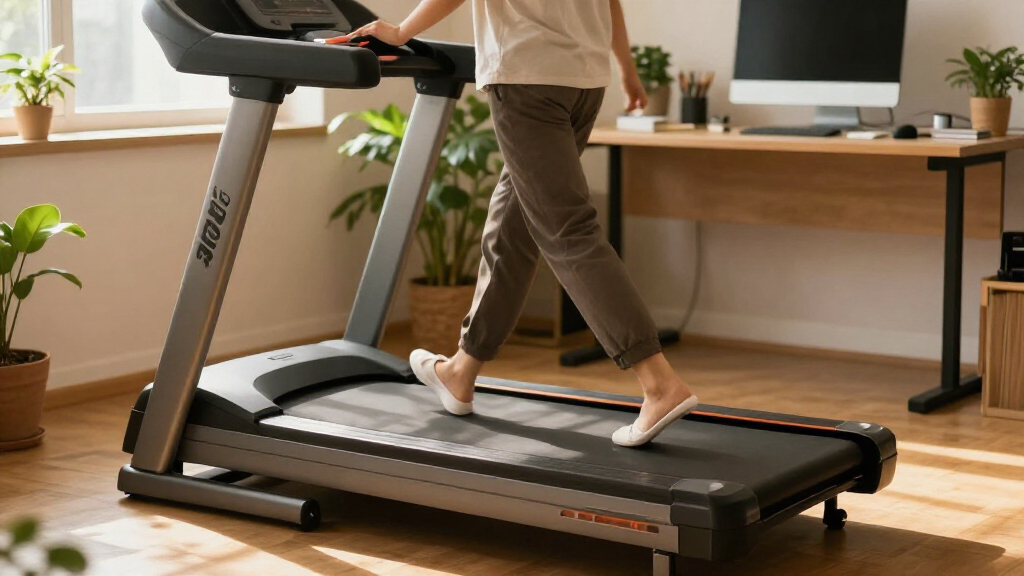
I ranked these treadmills around the demands of walking while working: how the incline is configured, what the product title reveals about walking space, whether handles can be folded or used for support, and how controls and connected features may affect everyday use. I also weighed the likely footprint and versatility implied by each design, since a treadmill that works for exercise may not fit neatly beneath a desk or store easily afterward.
The order gives the top spot to the MERACH W60 for its 12% automatic incline, then distinguishes picks by useful strengths rather than treating every extra as an advantage. The THERUN’s stated 40-inch belt and the Cybergoing T10’s fixed incline and Bosch motor make them compelling alternatives for different priorities. Models with handles, apps, speakers, or manual incline rank according to how well those features serve a clear buyer need; buyers should check full specifications, dimensions, and operating details before choosing, since product names alone do not confirm noise, weight capacity, or desk clearance.
Factors to Consider When Choosing Under Desk Treadmills
Choosing an under-desk treadmill is less about collecting features and more about matching the machine to your desk, walking habits, and available storage. I would check the practical fit first, then decide whether incline, handles, or connected controls will genuinely improve your routine.
Measure the Desk Opening and Storage Route
Measure the clear space between the floor and desk, including any crossbar, drawer, or cable tray that could obstruct the treadmill. Compare those measurements with the machine’s full height and handle configuration, not just its listed profile with handles folded. Also check the route from storage to desk: a pad can fit beneath a workstation yet be awkward to move through a doorway or around furniture. A folding frame may help with storage, but folded dimensions and the effort required to move it still matter. Avoid buying based on a product image alone, since perspective can make a treadmill look smaller than it is. Leave room to step on and off safely rather than filling the entire space beneath the desk.
Choose Belt Space for Your Stride
A longer or wider belt can make walking feel less constrained, especially if you have a longer stride or tend to drift while concentrating on work. The THERUN’s named 40-inch belt gives this roundup a concrete length reference, but buyers should check belt width as well as length before comparing models. Do not assume a compact pad will feel comfortable just because it fits under a desk. If possible, compare the belt dimensions with the space you naturally use when walking, and allow for a little margin at the front and rear. A larger walking surface may take up more floor space, so balance comfort against storage and desk clearance. For low-speed work sessions, a stable, usable belt may be more valuable than a higher maximum speed.
Decide Whether Incline Will Be Used Often
Incline can add variety and effort to a walking session, but it also affects how the machine fits and how easy it is to adjust between tasks. Automatic incline, featured on models such as the MERACH W60, TRAILVIBER, and WELLFIT, is suited to people who expect to change settings regularly. Manual incline can make sense for buyers who prefer a simpler setup and do not need frequent adjustments. A fixed incline, like the Cybergoing T10’s 7% grade, removes the need to choose a setting but offers less flexibility. Before paying for incline features, think about whether you will use them while working or reserve them for dedicated exercise. A steep setting may also be less compatible with typing or other focused desk tasks.
Treat Handles as a Fit and Safety Choice
Handles and handrails can offer a useful point of support, especially for people who are new to walking pads or plan to use the treadmill outside a desk-work routine. They may also make the machine taller or change how it folds and stores, so check both the raised and folded dimensions. A handle is not a substitute for a stable walking surface or careful setup. If you plan to walk while typing, consider whether the rail position leaves enough space for your arms and chair. Buyers who want the clearest under-desk profile may prefer a handle-free design, while those who value support may accept a larger footprint. Decide based on your actual use rather than assuming every added rail is automatically helpful.
Match Controls and Apps to Your Routine
A remote can make basic speed changes easier without reaching down, while an app may add workout tracking or other connected functions. The UREVO and Chaoke listings highlight app features, whereas several simpler models emphasize remote control. Before choosing an app-enabled treadmill, check which functions require a phone, whether the display remains readable at your desk, and what data the app records. For focused work, a straightforward control method can be less distracting than extra digital features. Also check whether essential adjustments are available without a paired device, since connectivity may not always be convenient. Choose the control system you will actually use rather than treating connectivity as a measure of quality.
Check Operating Limits and Ongoing Care
Product names do not tell the whole story about noise, weight capacity, motor duty cycle, or maintenance needs, so verify these details in the full manufacturer specifications before purchase. Noise matters especially in shared homes, video calls, and quiet offices; a motor description alone cannot guarantee a quiet experience. Check what lubrication or belt-alignment care the manufacturer recommends and whether parts or support are available. Review the stated maximum user weight and operating guidance against your own expected use. A treadmill used for short work breaks may face different demands from one running for hours each day. Paying for a feature-rich model makes more sense when its operating limits and care requirements match your routine.
Frequently Asked Questions
Can I use an under-desk treadmill while typing or taking video calls?
Many people use walking pads at a gentle pace for routine desk tasks, but walking can still affect typing accuracy, focus, and how steady you appear on camera. Start with short sessions and a speed low enough that you can speak and work comfortably. Keep the desk at a height that lets your arms rest naturally instead of reaching down toward the keyboard. If calls require stillness or precise presentation, plan to stop the belt rather than expecting to walk through every meeting. A treadmill’s stated features cannot predict how much motion you will tolerate while working.
Is automatic incline worth choosing over manual or fixed incline?
Automatic incline is most useful if you expect to change the grade during a session or want to vary effort without stopping to adjust the machine. Manual incline may be a better fit for a set-it-and-leave-it routine, while a fixed grade keeps the control scheme simple but limits your options. In this roundup, the MERACH W60, TRAILVIBER, and WELLFIT list 12% automatic incline, while the Cybergoing T10 specifies a fixed 7% grade. Think about whether you will use incline during work or only during separate exercise sessions. If frequent adjustment is unlikely, a simpler model may meet your needs without adding complexity.
Should I choose a treadmill with handles for under-desk walking?
Handles can provide a support point and may be appealing if you are new to walking pads or want to use the treadmill for more than desk walking. They can also interfere with desk clearance, chair placement, or storage, even when they fold. Compare the folded and raised dimensions with your actual workspace before choosing a rail-equipped design. If your main use is walking close to a desk, a handle-free model may leave a cleaner fit, but it will not provide the same support feature. Neither option removes the need to use the treadmill within its stated instructions and limits.
How much belt space do I need for comfortable walking?
The right belt size depends on your stride, how naturally you walk, and whether you can keep your attention on the belt while working. A longer belt can offer more room front to back, while width also affects how easily you can stay centered. The THERUN is the only product in this list whose name states a 40-inch belt, making it a useful reference point rather than a universal minimum. Check the full belt dimensions for every model you shortlist and compare them with your space and walking style. If you cannot try the machine first, confirm the return terms and measure your available floor area carefully.
What should I verify before putting a treadmill beneath my desk?
Measure the floor-to-desk clearance, including crossbars and drawers, and compare it with the treadmill’s height in the configuration you will use. Check the walking belt dimensions, maximum user weight, speed range, and any stated operating-time limits in the manufacturer’s specifications. For a shared workspace, look for operating-noise information rather than assuming a particular motor will be quiet. Confirm what maintenance is required and whether the treadmill can be moved or stored without help. Leave enough room around the machine to mount and step off safely, and follow the manufacturer’s setup and use instructions.
Conclusion
For the strongest mix of incline flexibility and under-desk versatility, I recommend the MERACH UltraWalk W60 as best overall. Buyers who want a longer stated belt should look closely at the THERUN, while the Cybergoing T10 is a distinct alternative for someone who prefers a fixed grade and a Bosch motor. For a best value-style choice centered on simple operation, compare the remote-controlled TOUSAINS and the 5% manual-incline Walking Pad or Wilpkracy, checking their full specifications before deciding. Beginners who want added support may prefer the folding-handle Viamotion or handrail-equipped WELLFIT, while buyers seeking connected features can shortlist UREVO or Chaoke. If your priority is compact, straightforward walking, favor a low-profile design and verify its dimensions; if you need incline, support, or app functions, choose the model whose specific feature you will use rather than paying attention to feature count alone.