TL;DR

Get workout gear delivered free with Prime
- Fast, free delivery on millions of items
- Prime Video, Amazon Music and more included
- Member-only deals all year
Fit&Well reports that Jill Brown, a 59-year-old trainer and Pilates instructor, avoids heavy weights because of injuries and uses lighter resistance with more repetitions. She recommends beginners start with six to eight repetitions and build gradually through a six-exercise band workout.
Trainer Jill Brown, 59, says she has stopped lifting heavy weights because of injuries and instead uses lighter resistance and repetitions to challenge her muscles. In a Fit&Well report, she recommends a 30-minute resistance-band workout for beginners, advising them to start at six to eight repetitions per move and increase gradually while maintaining good form.
Brown is described by Fit&Well as a board-certified health and wellness coach, personal trainer and Pilates instructor. She told the publication that heavy lifting is no longer part of her routine because of injuries. Her approach relies on lighter-to-moderate resistance, with repetitions adjusted to make the exercises challenging. The report does not specify the nature of her injuries or provide independent evidence about her personal strength.
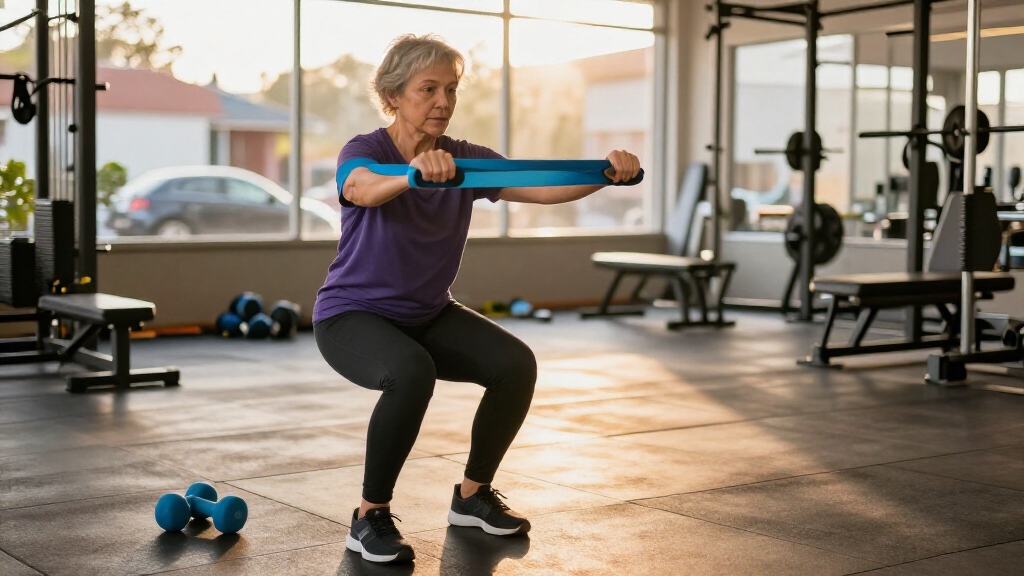
“I’m a fan of 20 reps,” Brown told Fit&Well, explaining that she uses higher repetitions in her own training. But she does not suggest that beginners start there. “For a beginner, start at six to eight reps and work your way up,” she said. Her proposed routine calls for two to three sets of six exercises: squats, forward lunges, bent-over rows with a band, banded lat pulls, a child’s-pose-to-kneeling push-up and a banded floor press. The plan requires a long-loop and a short-loop resistance band.
Brown’s progression advice is to begin at a manageable level, record what can be done with good form, then add repetitions or time in small steps. She gives a plank as an example: start with 20 seconds if that is manageable, then add five seconds the following week. The workout report does not set a required weekly schedule, rest periods or a fixed timeline for moving beyond the starting repetitions.
A Lower-Equipment Route to Strength
The routine offers readers an option for strength training that does not require heavy weights, a gym membership or bulky equipment. That may make it more approachable for people returning to exercise or unsure about using weights, although the report does not establish that resistance bands are suitable for everyone or a substitute for individualized advice.
Brown’s emphasis on starting within one’s ability and increasing gradually is central to the recommendation. Readers should treat the six-exercise sequence as a general workout, not a personalized prescription. People with injuries, pain, health conditions or uncertainty about safe movement can consult a qualified health professional before beginning, and should stop if an exercise causes pain.
Why Brown Uses Lighter Resistance
Fit&Well frames Brown’s recommendation against common advice to use strength training as people get older. The report notes that some readers may hesitate to lift weights because they are recovering from injury, have not exercised recently, or do not want to buy equipment or join a gym. Brown’s account is a personal example of adapting training, not a clinical assessment of what every older adult should do.
Her method pairs lighter resistance with more repetitions. She told Fit&Well that research shows muscle can grow with lighter-to-moderate weights, but the report does not cite particular studies or detail their findings. The article also does not compare the routine’s results with a heavy-weight program. Its practical focus is on a beginner sequence and a gradual way to increase repetitions.
““I don’t lift heavy because of injuries.””
— Jill Brown, as quoted by Fit&Well
Limits of the Workout Report
The report presents Brown’s personal experience and recommended routine, but it does not provide a date, explain the cause or severity of her injuries, or independently verify her claim that she is stronger than ever. It also does not cite the research she refers to on muscle growth with lighter-to-moderate weights.
Several details a beginner might want are not specified, including how often to repeat the workout, how long to rest between sets, how to select band resistance, and when to progress to a stronger band. The routine’s suitability for people with particular injuries or medical conditions is also not established. Readers should not interpret Brown’s experience as a guarantee of results.
How Beginners Can Start Safely
Brown’s recommendation is to begin with six to eight repetitions per exercise, using a level of resistance that allows controlled movement and good form. The report says to add repetitions incrementally each week, but does not prescribe a set progression schedule; readers can use the example of adding five seconds to a plank only as an illustration of gradual increases, not as a requirement for this workout.
Before starting, beginners can check that their bands are in good condition and that the exercise setup feels stable. Anyone recovering from an injury or managing a health condition should seek guidance from a qualified professional about appropriate movements and resistance. Fit&Well’s report does not announce a follow-up or additional testing, so any broader assessment of the program’s results remains unavailable.
Key Questions
Who is Jill Brown?
Fit&Well describes Brown as a 59-year-old board-certified health and wellness coach, personal trainer and Pilates instructor. She told the publication that injuries led her to stop lifting heavy weights.
What exercises are in Brown’s beginner workout?
The six moves are squats, forward lunges, banded bent-over rows, banded lat pulls, child’s-pose-to-kneeling push-ups and banded floor presses. The plan uses long- and short-loop resistance bands.
How many repetitions does she recommend for beginners?
Brown recommends starting at six to eight repetitions per exercise and increasing gradually while keeping good form. The workout lists two to three sets per move.
Does Brown say beginners should do 20 repetitions?
No. Brown says she personally likes 20 repetitions, but her beginner guidance is to start at six to eight and work up over time.
Is the workout appropriate for someone with an injury?
The report does not establish that the routine is safe for any specific injury. People recovering from injury, experiencing pain or managing a health condition should seek professional guidance before starting and stop if a movement causes pain.
Source: rss
Halloween Picks
halloween
As an affiliate, we earn on qualifying purchases.