
TL;DR

Get workout gear delivered free with Prime
- Fast, free delivery on millions of items
- Prime Video, Amazon Music and more included
- Member-only deals all year
Fit&Well recommends shoulder presses, bodyweight squats, planks, dumbbell rows and glute bridges as a beginner home-strength routine. Personal trainer Chris Browning says the exercises are relatively simple to learn and can be progressed; the report suggests starting with light dumbbells.
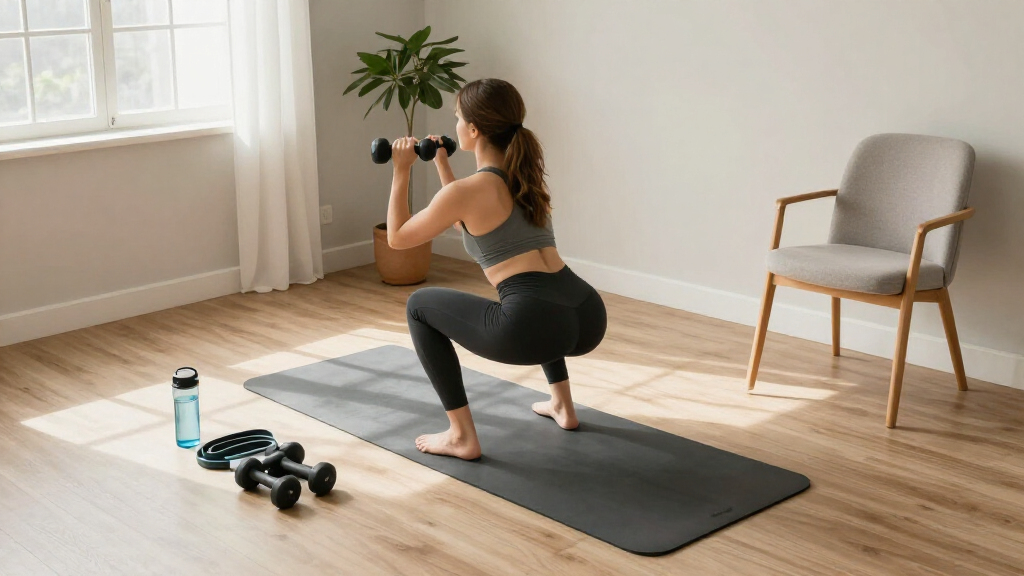
Fit&Well has published a five-exercise home-strength routine for complete beginners, featuring shoulder presses, bodyweight squats, planks, dumbbell rows and glute bridges. Personal trainer Chris Browning, who the report says has more than 20 years of experience creating home workouts, recommends the movements as a relatively simple way to work major muscle groups with limited equipment.
The routine calls for two to three sets of each exercise. For the shoulder press, squat, row and glute bridge, the suggested range is 10 to 15 repetitions; the row is performed on each side. The plank is held for 30 to 60 seconds, with Browning advising beginners to stop when the position becomes challenging or uncomfortable, or when they can no longer keep good form.
The equipment requirement is a pair of fairly light dumbbells for the shoulder press and row. The other three movements use body weight. The report suggests beginning with a load that lets the trainee challenge their muscles safely, then considering a weight increase after practicing for a few weeks if the exercises start to feel easy.
Form cues include keeping the core braced during presses and squats, aligning the knees with the toes during squats, and maintaining a flat back during rows. For the glute bridge, the hips lift until the body forms a line from chest to knees, with the glutes squeezed at the top. These are the report’s instructions; it does not provide a full weekly schedule or individualized coaching.
A Simple Routine With Little Equipment
The list offers beginners a defined starting point rather than requiring a gym or a complicated exercise plan. Three of the five movements need no weights, while a single pair of dumbbells supports the two upper-body exercises. The selected movements cover pushing, pulling, lower-body work and core stability, which is why Browning describes them as collectively targeting major muscle groups.
That makes the routine practical for people who want to begin strength training at home, but it is not a promise of a particular result. The source gives general set and repetition suggestions, not evidence that this exact combination is superior to other beginner programs. Individuals may need to adapt movements to their ability, available space or health needs.
Products Worth Considering

BowFlex Results Series SelectTech Adjustable Dumbbells (Pair)

Levoit Eleva 300X HEPA Air Purifier for Home and Bedroom

Bowflex SelectTech 840 Adjustable Kettlebell
As an affiliate, we earn on qualifying purchases.
How the Five Moves Were Chosen
Fit&Well attributes the exercise selection to Browning, a personal trainer whose reported experience includes more than 20 years creating home workouts. He says the moves are comparatively easy to teach and learn, allow for progression and, taken together, work major muscles efficiently. Those are his reasons for choosing them, rather than the result of a comparative study described in the article.
The report presents a progression approach based on practice: start with light dumbbells and consider increasing the weight after a few weeks if the movements feel easy. It does not specify a precise increase, how many days each week to train, or how much rest to take between sets. Its advice is therefore a basic exercise outline, not a complete individualized training plan.
Limits of the Published Guidance
The supplied report does not give a publication date, identify a research study supporting the routine, or say that the five exercises are the only or best option for every beginner. It also does not provide a weekly frequency, rest intervals, warm-up instructions, or adjustments for injuries and health conditions. Those details remain unspecified.
Readers should treat the suggested repetitions and timings as general guidance, not a personalized prescription. The source does not explain how to choose an exact dumbbell weight or how to modify the exercises for pain, limited mobility or other individual circumstances.
Progress Gradually and Keep Form
The report’s next step for trainees is to practice the movements with manageable resistance and sound technique. If the exercises feel easy after a few weeks, it suggests increasing the dumbbell weight, though it does not specify by how much. For planks, its guidance is to end the hold when form cannot be maintained or the position becomes uncomfortable.
Anyone with a pre-existing condition, injury or uncertainty about safe exercise can seek guidance from a qualified health professional or fitness instructor before starting or changing a routine. The source provides no later update or follow-up milestone.
Key Questions
Which five exercises does the routine recommend?
Fit&Well lists a seated dumbbell shoulder press, bodyweight squat, plank, dumbbell row and glute bridge.
What equipment is needed?
The routine uses a pair of fairly light dumbbells for presses and rows. Squats, planks and glute bridges are body-weight exercises.
How many sets and repetitions are suggested?
The report suggests two to three sets. It gives 10 to 15 repetitions for the press, squat and glute bridge, and 10 to 15 per side for rows. Planks are listed at 30 to 60 seconds, with form as the stopping guide.
When should a beginner increase the dumbbell weight?
Fit&Well suggests considering a weight increase after a few weeks of practice if the exercises start to feel easy. It does not specify an exact amount to add.
Source: fitandwell.com