TL;DR
A Fit&Well contributor says he introduced his 73-year-old father to three dumbbell exercises after the father had let strength training slide while caring for his wife. The routine pairs goblet squats, single-arm rows and overhead presses; the report describes the contributor’s experience, not a clinical study or proof of outcomes.
Fit&Well has published a first-person account of a contributor introducing his 73-year-old father to a three-move dumbbell routine, after the father had recently neglected strength training while caring for his wife, who has Parkinson’s. The routine consists of a goblet squat, single-arm row and overhead press; the report presents it as one family’s approach to fitting strength work into limited time, not as a tested program with measured results.
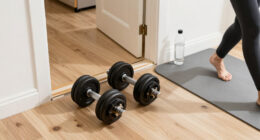
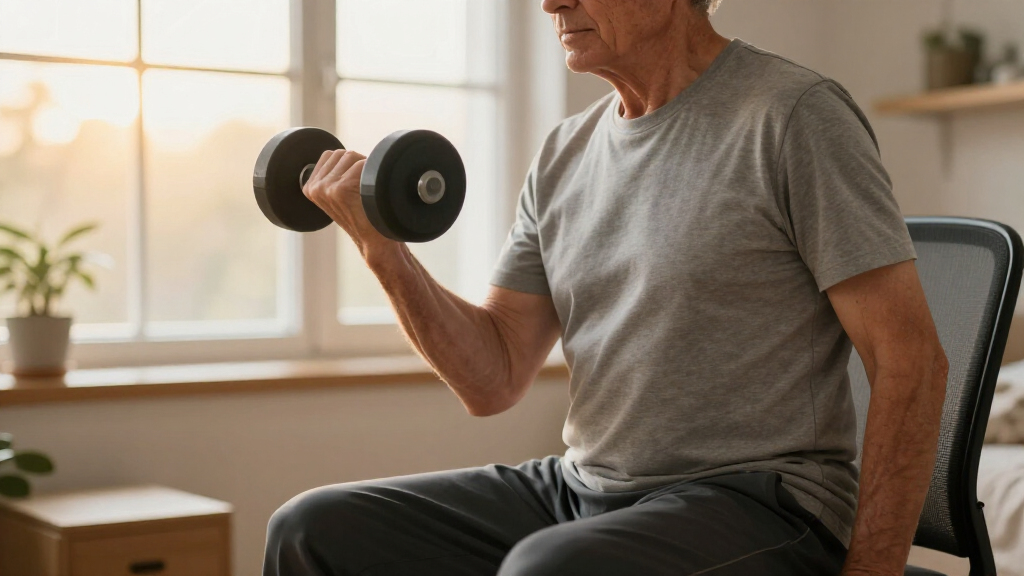
The contributor said his father had previously been active but had less time for himself because of his caregiving responsibilities. Writing that he approached the plan with his personal-trainer experience, the contributor said he bought his father light-to-medium dumbbells and reviewed how to hold weights, brace the core and maintain an upright position. They spent several weeks practicing bodyweight movements, including squats, hip hinges, lunges and pushing actions, before adding the three selected exercises.
For each move, the report suggests three sets of eight to 12 repetitions. In the goblet squat, the dumbbell is held at the chest while the person bends the knees and hips, then presses through the heels to stand. The contributor connects the motion to everyday tasks such as rising from a chair or picking something up. He suggests beginning with a bodyweight squat or using a chair for support if needed.
The single-arm row is performed with one hand supported on a sturdy surface while the other pulls a dumbbell toward the ribs from a hip-hinged position. The overhead press starts with dumbbells at shoulder height and presses them upward. The report offers a kneeling version of the row for added stability and a seated, back-supported press as an easier option. It does not state what weights the father used, how often he performed the routine, or whether his strength or mobility changed.
Three Exercises Tied to Daily Tasks
The routine’s stated rationale is that strength movements can resemble actions people use at home: standing up, lifting objects and reaching overhead. Those examples help explain why the contributor chose a squat, a pulling exercise and a press rather than a longer list of isolated movements. The proposed format may also be relevant to readers who have limited time, since the report focuses on three exercises rather than a full gym program.
But the account is not evidence that this particular routine improves function for all older adults. It contains no assessment, comparison group or reported measurements. The exercises and progressions are the contributor’s recommendations, and a person’s ability to do them safely depends on their health, balance, mobility and experience. Readers should treat the story as an individual example rather than a universal prescription.
From Bodyweight Practice to Dumbbells
The Fit&Well contributor said his father’s strength work had fallen away as caregiving took up more of his time. The report describes a gradual lead-in: the pair practiced bodyweight patterns for a few weeks before using weights. That sequence is part of the account’s practical context, because the contributor did not describe starting with loaded exercises immediately.
The article also gives modifications rather than presenting one version as suitable for everyone. A chair-assisted sit-to-stand can reduce the demands of the squat; kneeling can make the row steadier; and a seated press with back support can change the overhead exercise. The report says a heavier weight or a push press can make the press harder, but it does not provide a progression schedule or specific criteria for increasing resistance.
“He cares for my mother, who has Parkinson’s, so he ends up with little time for himself.”
— Fit&Well contributor, describing the reason for helping his father
No Measured Results Reported
The report does not give the father’s training frequency, the dumbbell weights, the length of time he followed the routine, or any before-and-after results. It also does not say whether he had medical advice or an assessment before beginning. The claim that the exercises support strength and mobility is presented as the contributor’s rationale; the article supplies no study data establishing what this father gained.
It is also unclear whether the routine would suit someone with pain, balance difficulties, limited shoulder movement or a health condition affecting exercise. The source does not describe supervision during every workout or set out a formal safety protocol. The suggested repetitions and easier variations should not be read as individualized medical guidance.
How Readers Should Apply the Example
The source does not announce a follow-up, a new training plan or further results for the father. Its practical next step for readers is to use the movements as an example, not to copy the loads automatically: start with a version that can be performed with control, and use the report’s supported or bodyweight alternatives where appropriate. Anyone uncertain about starting resistance exercise, or managing an existing condition or injury, should seek guidance from a qualified health professional or exercise professional before trying the routine.
Further reporting would be needed to establish how often the father trained, whether the exercises were adjusted over time and whether he experienced measurable changes. Until then, the confirmed development is the publication of a contributor’s personal account and exercise suggestions, rather than evidence of a demonstrated fitness outcome.
Key Questions
Which three exercises are in the routine?
The Fit&Well report lists a dumbbell goblet squat, single-arm dumbbell row and dumbbell overhead press.
How many sets and repetitions does the report suggest?
It suggests three sets of eight to 12 repetitions for each exercise. That is the article’s suggested format, not a personalized prescription.
Did the report show that the routine improved the father’s strength?
No measurements or before-and-after results are provided. The contributor explains the routine’s intended purpose, but the report does not establish a specific outcome for his father.
What easier versions does the article describe?
It suggests bodyweight or chair-assisted squats, a kneeling row for stability, and a seated overhead press using a chair with back support. People with health concerns or movement limitations should ask a qualified professional what is appropriate for them.
Source: rss